
Production ML Classification Pipeline
XGBoost with versioned datasets, MLflow tracking, monitored batch inference, and rollback.
- Role
- Senior engineer · ML pipeline and MLOps
- Core stack
- XGBoostMLflowPythonVersioned datasetsBatch inference
Overview
Took an XGBoost classification model from experiment to production with reproducible data, tracked experiments, monitored batch inference, and a defined rollback path.
A model is only useful in production if its results are reproducible, its behavior is monitored, and a bad release can be reversed quickly.
Product walkthrough
The flow, screen by screen
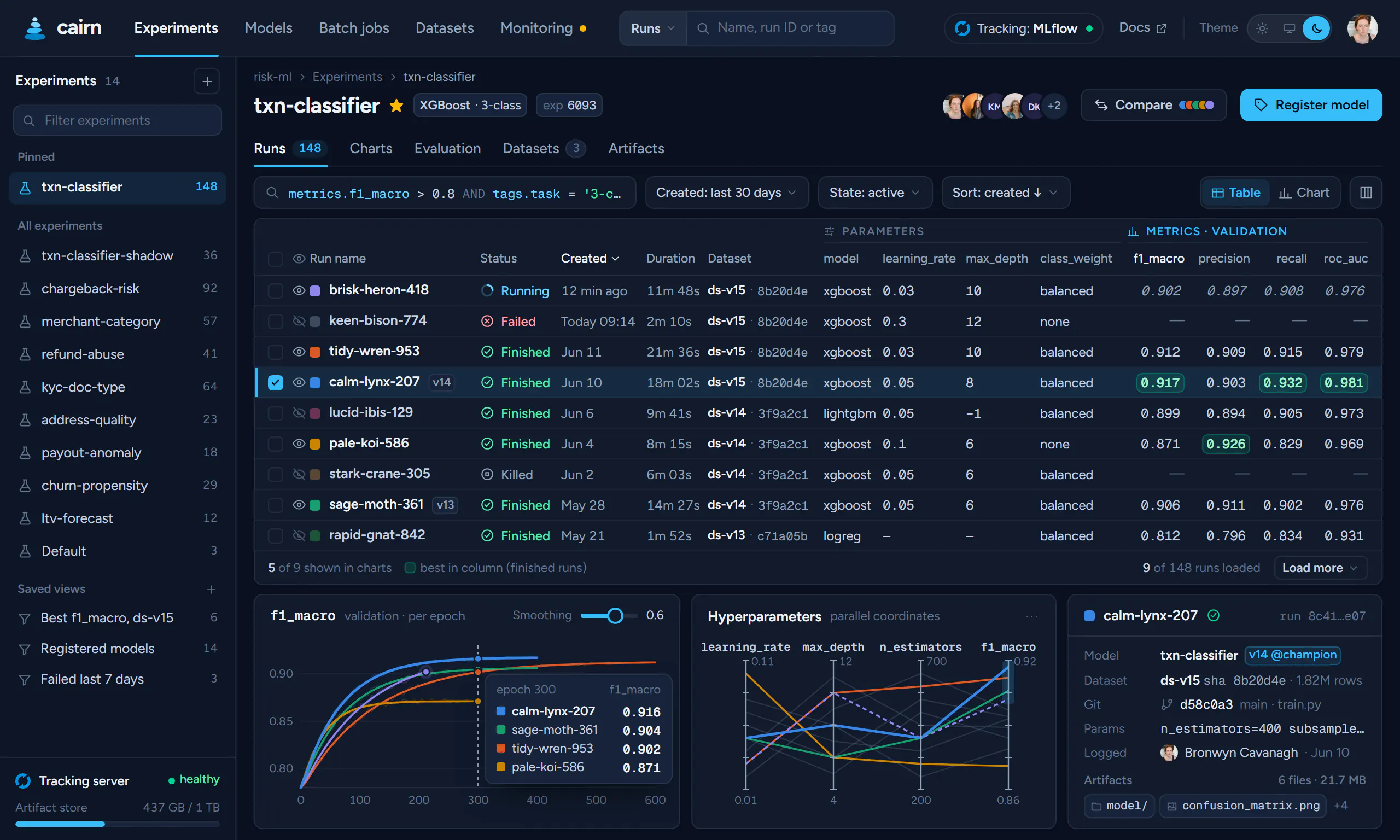
Experiment tracking. Every training run is tracked in MLflow with its parameters, metrics, and the exact dataset version it used.
Approach
- 01Versioned training datasets so every model can be traced back to its exact data.
- 02Tracked experiments and model versions with MLflow.
- 03Ran scheduled batch inference with monitoring on its outputs.
- 04Defined rollback procedures to restore the previous model version when needed.
Key decisions
Batch over real-time inference
Batch scoring fit the use case and kept the system simpler to monitor and operate.
Rollback as a first-class step
A documented way back makes releasing new models low-risk.
Outcomes
- Reproducible, auditable model releases.
- Monitored batch inference in production.
- XGBoost
- MLflow
- Python
- Versioned datasets
- Batch inference
- Monitoring
Working on something similar?
I work with clients worldwide, across any time zone. Tell me what you're building.